









Get the Truth
Anti-competitive government-mandated project labor agreements (PLAs) are special interest schemes that end open, fair and competitive bidding on taxpayer-funded construction projects.
Government-mandated PLAs discourage merit shop contractors from competing for and winning contracts for construction projects funded by taxpayer dollars. Construction contracts subject to government-mandated PLAs are almost always awarded exclusively to unionized contractors and their all-union workforces. Less competition and archaic and inefficient union work rules and featherbedding required by PLAs needlessly increase the cost of construction projects.
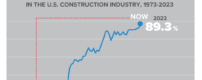
According to the most recent data from the U.S. Department of Labor’s Bureau of Labor Statistics, just 11.7 % of the 2022 U.S. private construction workforce belonged to a union. This means PLAs, when mandated, discriminate against nearly 9 out of 10 construction industry employees who want nothing more than to rebuild their communities at a price that is best for taxpayers but have chosen not to affiliate with a union.
The following provisions in PLAs typically discourage merit shop contractors from competing to win construction contracts subject to government-mandated PLAs:
- PLAs require merit shop companies to obtain most or all of their construction workers from union hiring halls. This means a merit shop company must exclusively use unfamiliar union workers on specific jobsites instead of their own skilled and experienced employees. In rare instances, merit shop employers can use a limited number of their own employees, but employers must send their nonunion employees to the union hiring hall and hope the union sends the same employees back to that specific PLA jobsite.
- Nonunion employees may have to pay union dues and fees and/or join a union in order to work on a PLA project, although these requirements can be less onerous in Right-to-Work states.
- Despite the fact contractors have their own benefits plans, PLAs require merit shop contractors to pay their workers’ health and retirement benefits to union benefit and pension funds. Thus, companies have to pay benefits twice: once to the union and once to the company plan.
- Construction workers could suffer wage theft due to government-mandated PLAs as nonunion workers (and some union workers) lose an estimated 34% of wages and benefits earned on a PLA project unless they accept union representation, join a specific union, pay membership dues and meet the union benefits plan’s vesting requirements.
- Paying into underfunded and mismanaged union pension plans can expose merit shop contractors to significant pension withdrawal liabilities, as documented in this legal case, for example. Signing a PLA and exposing a company to pension liabilities could bankrupt a contractor or prohibit contractors from qualifying for construction bonds needed to build future projects.
- PLAs require merit shop companies to obtain apprentices exclusively from union apprenticeship programs. Participants in federal and state-approved nonunion apprenticeship programs registered with the U.S. Department of Labor or equivalent state entities—as well as participants in non-registered industry and educational programs—typically cannot work on a job covered by a PLA. This means craft professionals enrolled in apprenticeship programs other than those offered by a union are excluded from work in their hometowns, choking off a viable and critical workforce development pipeline as the construction industry faces an estimated half a million person shortage of skilled labor in 2023.
- PLAs force contractors to follow inefficient and archaic work rules defined in the PLA or existing collective bargaining agreements for each trade on the jobsite.
Learn more about the provisions in typical PLAs and how they harm nonunion contractors and employees at “Understanding Core Workforce Provisions in Project Labor Agreements” (4/7/14) and “Project Labor Agreement Basics: What Is a PLA?” (4/24/09).
PLAs drive up the cost of construction projects. By unnecessarily limiting bidders and following outdated and inefficient union work rules, PLAs consistently and unnecessarily drive up costs on projects. Analysis of numerous academic studies of taxpayer-funded school construction and affordable housing projects already subject to prevailing wage laws indicate government-mandated PLA increase the cost of construction between 12% and 20% when compared to similar projects not subject to PLA mandates.
PLAs discriminate against merit shop contractors and disadvantaged businesses. This discrimination is particularly harmful to women- and minority-owned construction businesses—whose workers traditionally have been under-represented in unions in many markets, mainly due to artificial and societal barriers in union membership and union apprenticeship and training programs. Get the facts about the discriminatory impact of union-favoring PLAs on women- and minority-owned construction businesses and workers.
PLAs harm local workers. Proponents claim PLAs ensure the use of local workers, but the truth is PLAs take away jobs from local workers. PLA lobbyists fail to mention the term local workers excludes qualified local nonunion, women, minority and veteran construction workers employed by nonunion contractors excluded by PLA mandates. This rhetoric is particularly misleading because only 12.6% of U.S. construction workers belong to a union. In construction markets where the demand for union labor is greater than the supply, union workers from outside the local area are given preference over qualified local nonunion workers on PLA projects. These union workers are called travelers or boomers, and they take jobs away from local qualified nonunion craft employees. Anecdotal evidence in many areas of the country suggests that PLAs don’t result in better local hire outcomes.
PLAs take away employee’s rights. Employees normally are permitted to choose whether to join a union through a card check process or a federally supervised private ballot election. PLAs require unions to be the exclusive bargaining representative for workers during the life of the project. The decision to elect union representation is made by the employer —when agreeing to participate in a PLA—rather than the employees. PLAs are called pre-hire agreements because they can be negotiated before the contractor hires any employees or employees vote on union representation. The National Labor Relations Act (NLRA) generally prohibits pre-hire agreements, but an exception in the law allows for these agreements only in the construction industry. In short, government-mandated PLAs strip away the right of construction workers to a federally supervised private-ballot election or a card check election when deciding whether to unionize their workplace. PLAs can be less onerous on nonunion construction workers in Right to Work states but workers can be forced to pay agency shop fees to unions as a condition of employment in certain circumstances.
PLAs are not necessary to, and are not successful at, ensuring labor peace or keeping a project safe, on time, on budget, or in compliance with labor laws. Unions leverage the threat of labor strikes and unrest to compel construction users to require PLAs on construction projects. This is a particularly disingenuous argument that flirts with blackmail because unions cause many project delays through illegal organizing and jurisdictional disputes. In addition, construction unions have repeatedly struck on prominent PLA projects and strikes are increasingly rare in today’s construction industry, calling into question the value of the agreements. In contrast, merit shop workers do not strike, yet they are typically discouraged from working on PLA projects.
As documented in the following linked blog posts, government-mandated PLAs do not guarantee a safe jobsite, nor do PLA mandates ensure compliance with labor laws. Some courts have found PLA mandates violate state and federal competitive bidding laws. In fact, some unions and unionized contractors oppose PLA mandates.
A report by ABC general counsel Maury Baskin, Government-Mandated Project Labor Agreements: The Public Record of Poor Performance (2011 Edition), documents the numerous broken promises and mishaps on government-mandated PLA construction projects, such as the infamous Big Dig in Boston.
Additional research and studies on the cost and negative impact of government-mandated PLAs is available here.
To learn more about PLAs, contact the team at Associated Builders and Contractors or visit www.facebook.com/TheTruthAboutPLAs and @TruthAboutPLAs and leave us a note.
75 Responses to Get the Truth
[…] delays through illegal organizing and jurisdictional disputes on jobsites,” according to an analysis posted on the ABC website. “Merit shop workers do not strike, yet they are excluded from working […]
[…] Globe column by Scot Lehigh criticizes Massachusetts Governor Deval Patrick’s support of project labor agreements (PLAs) on future construction projects in exchange for political support from construction trade […]
[…] an April 14 Wall Street Journal editorial blasts President Obama’s Feb. 6, 2009 pro-project labor agreement (PLA) Executive Order 13502 that was implemented into federal procurement regulations via a final […]
[…] discussed the problems with the April 13 final rule implementing President Obama’s pro-PLA Executive Order 13502 with David Asman of FOX Business Network’s “America’s Nightly […]
[…] project delays through illegal organizing and jurisdictional disputes on jobsites," according to an analysis posted on the ABC website. "Merit shop workers do not strike, yet they are excluded from working on […]
[…] unemployment. But it is good news for Big Labor.The schemes are called government-mandated project labor agreements (PLAs) and the Obama administration is encouraging federal agencies to use them on a […]
[…] agreements (PLAs). PLAs are a complete sop for unions. They insist on using union workers, which increases the cost of construction projects on average by 10 to 20 […]
[…] normal workforce of non–union members or choose not to bid on the project. Considering only 14.5 percent of construction workers are unionized, there is no other reason for PLAs other than as a sop to Democrats’ key […]
[…] in the City of Palmdale, in Los Angeles County) from requiring its contractors to sign Project Labor Agreements (PLAs) with […]
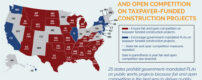
[…] prohibit those states from entering into contracts that require construction contractors to sign Project Labor Agreements with unions. See the map above, courtesy of […]
[…] their local governments from entering into contracts that require construction companies to sign Project Labor Agreements (PLAs) with construction trade […]
[…] that prohibit those cities from entering into contracts that require construction companies to sign Project Labor Agreements (PLAs) with unions. On April 26, Governor Brown signed Senate Bill 829 into law – only a […]
[…] their local governments from entering into contracts that require construction companies to sign Project Labor Agreements (PLAs) with construction trade […]
[…] project in California, assume that the government or the developer required contractors to sign a Project Labor Agreement to build […]
[…] in the City of Palmdale, in Los Angeles County) from requiring its contractors to sign Project Labor Agreements (PLAs) with […]
[…] certainly the silent #1 issue in the race for Placer County Board of Supervisors, 4th District is Project Labor Agreements, also known as […]
[…] ordinance would prohibit the City of San Diego from requiring construction companies to sign a Project Labor Agreement (PLA) with unions as a condition of working on a taxpayer-funded project. It also contains language […]
[…] in ”membership dues” (paid by power plant owners and contractors as a condition of Project Labor Agreements extracted by California Unions for Reliable Energy), and $450,000 in net investment returns. A […]
[…] the proposed ordinance is unnecessary because the city has never required contractors to sign a Project Labor Agreement with unions for a taxpayer-funded project. Apparently the No on A campaign thinks the illogical […]
[…] Open Competition ordinance prohibiting the city from requiring construction contractors to sign a Project Labor Agreement to work on taxpayer-funded construction. I also reported already on the 57% victory in the City of […]
[…] Board of Harbor Commissioners for the Port of Long Beach held a special study session to discuss Project Labor Agreements (PLAs) on specific projects and a proposed Project Labor Agreement that construction contractors would […]
[…] Don’t worry about the unions; they have a good deal with their union monopolies through Project Labor Agreements (PLAs) at dozens of local governments – you know, all the fiscally responsible and […]
[…] will be a requirement for the design-build entities and their subcontractors to sign a Project Labor Agreement with unions for some or all of the construction work. I provided extensive background information […]
[…] labor law compliance activity on these projects because contractors working on them have to sign a Project Labor Agreement with unions. (See the special SDUSD “Project Stabilization Agreement” web page here for […]
[…] lawyers exploit California’s environmental protection laws to squeeze union-only Project Labor Agreements (PLAs) out of private developers. Not surprisingly, the public reaction is overwhelmingly […]
[…] of parents and students will see their construction program compromised by a government-mandated Project Labor Agreement that cuts bid competition and increases costs for the benefit of construction […]
[…] Whatever happens, union officials will probably allign with whichever side serves their own interest of gaining full control of construction for this development with a Project Labor Agreement. […]
[…] et seq.) so that unions can’t exploit it to block proposed projects until the owner signs a Project Labor Agreement giving unions monopoly control of the construction […]
[…] power generation, although some people speculate that their CURE client is more interested in Project Labor Agreements for these projects. Category: California Environmental Quality Act (CEQA), Lawsuit Abuse, […]
[…] owners of proposed power plants (and their construction contractors) fund it when they sign Project Labor Agreements (PLAs) that require payments to […]
[…] the Sonoma County Board of Supervisors directed county staff on September 18, 2012 to negotiate a Project Labor Agreement (PLA) with unions and with the input of contractors for the planned $84 million expansion of the […]
[…] the Sonoma County Board of Supervisors directed county staff on September 18, 2012 to negotiate a Project Labor Agreement (PLA) with unions and with the input of contractors for the planned $54 million expansion of the […]
Nice post. Very good info.
[…] is to coerce developers to hand over monopoly control of the construction to unions through a Project Labor Agreement. The CEQA abuse racket is called “greenmail,” and it is rampant throughout […]
[…] is to coerce developers to hand over monopoly control of the construction to unions through a Project Labor Agreement. The CEQA abuse racket is called “greenmail,” and it is rampant throughout […]
[…] week the U.S. Department of Labor (DOL) confirmed the elimination of a controversial project labor agreement (PLA) mandate on its estimated $20 million to $50 million Job Corps Center in Manchester, N.H., when […]
[…] California Environmental Quality Act (CEQA) to block proposed projects until the developer signs a Project Labor Agreement for construction and a neutrality agreement leading to a collective bargaining agreement for the […]
[…] of Education of the San Diego Unified School District requires construction contractors to sign a Project Labor Agreement with unions in order to work on certain projects funded by school district bond sales. Coalition […]
[…] have succumbed to the union political agenda and require their construction contractors to sign a Project Labor Agreement with trade unions as a condition of working on taxpayer-funded […]
[…] succumbed to the union political agenda and now require their construction contractors to sign a Project Labor Agreement with trade unions as a condition of working on taxpayer-funded projects. And unions are busy […]
[…] getting a Project Labor Agreement and other labor concessions as part of a deal to withdraw their environmental complaints about the […]
[…] getting a Project Labor Agreement and other labor concessions as part of a deal to withdraw their environmental complaints about the […]
[…] established this policy to provide a strong incentive for construction contractors to sign a Project Labor Agreement with unions for construction of the $68 billion-$100 billion rail system, including related […]
[…] Community Benefit Agreements usually include a requirement for developers or contractors to sign a Project Labor Agreement with construction unions or adopt some other program (often a “First Source Hiring” […]
[…] from multiple sources that top construction union officials in Sacramento were anticipating a Project Labor Agreement (PLA) if Sacramento County voters approved a proposed $1.2 billion sales tax increase in the November […]
[…] has documented why government-mandated project labor agreements (PLAs) are opposed by some union contractors and union members for a variety of […]
[…] government officials and taxpayers there is a public benefit to anti-competitive and costly government-mandated project labor agreements (PLAs), which create jobs exclusively for unionized construction workers and steer huge public […]
[…] government officials and taxpayers there is a public benefit to anti-competitive and costly government-mandated project labor agreements (PLAs), which create jobs exclusively for unionized construction workers and steer huge public […]
[…] http://thetruthaboutplas.com/get-the-truth/ […]
[…] of the Courts for the State of California (AOC) have been “negotiating” a union-only Project Labor Agreement (PLA) for the new $600+ million Superior Courthouse to be located in downtown San Diego. The AOC has […]
[…] law, which will prohibit government entities in the state from requiring contractors to sign a project labor agreement (PLA) or other agreements with labor unions as a condition of performing work on public […]
[…] According to a press release by the New York City District Council Carpenters Union, hundreds of carpenters union members went on strike Monday—affecting major construction projects around New York City and New Jersey, including some covered by project labor agreements (PLAs). […]
[…] shop contracting community for their opposition to an anti-competitive and costly union-favoring government-mandated project labor agreement (PLA) on the U.S. Department of Labor’s (DOL) Manchester, N.H., Job Corps […]
[…] Francisco 49ers’ $1.2 billion Levi’s stadium, subject to a controversial government-mandated project labor agreement (PLA), has been plagued by two fatal jobsite accidents and a protest by a coalition […]
I am Mark Corbin Director of the Small Business Enterprise (SBE) program and I would like to come and share information regarding our program and how we can assist minority contractors.
My contact information is as follows:
Mark Corbin, Director
Small Business Enterprise Supportive Services Center
Cheyney University of Pennsylvania
1837 University Circle
P.O. Box 200
Cheyney, Pennsylvania 19319-0200
[email protected]
610-399-2178 (o)
610-399-2118 (f)
855-PASBE4U (727-2348)
http://www.pennsbess.com
Twitter: @SBESSCPA
I WANT FAIR COMPETETION
[…] to maintain roads of any state in the country. A terrific resource on project labor agreements—TheTruthAboutPLAs.com— explains that the vast majority (more than 85%) of the private construction workforce belong to […]
[…] to maintain roads of any state in the country. A terrific resource on project labor agreements—TheTruthAboutPLAs.com— explains that the vast majority (more than 85%) of the private construction workforce belong to […]
[…] Get the Truth, The Truth About PLAs […]
The main reason costs are “elevated” is because the workers on the PLA jobs receive actual wages and benefits with which they can support their families and actually put some of that wage back into the community which is good for the economy. The idea that a PLA in is bad is one of the biggest jokes I have ever heard. The only ones against PLAs are those that have no concern for the health and welfare of the working class
Projects subject to government-mandated PLAs are typically subject to federal Davis-Bacon laws or state and local prevailing wage laws, which require payment of locally “prevailing” wage rates and fringe benefits to employees of contractors and subcontractors performing work on qualifying construction projects. On projects subject to the federal Davis-Bacon Act, the U.S. Department of Labor’s Wage & Hour Division (WHD) is responsible for conducting surveys to establish the wage rates applicable to such projects. The rates required are typically the union collectively bargained wage and benefit rate, although sometimes a few trades are determined through a blended rate of market and union rates. States and localities either use the WHD rate or calculate their own rates via a state agency. In short, the wage and benefit rates are able to support families with or without a PLA mandate. The added costs because of PLA mandates are frequently due to a lack of competition, inefficient union work rules and delays and complications during the procurement process. You can’t cut competition from the majority of the construction industry and expect it to have no impact on price or quality.
[…] this policy to provide a strong incentive for construction contractors to sign a Project Labor Agreement with unions for construction of the $68 billion-$100 billion rail system, including related […]
[…] this policy to provide a strong incentive for construction contractors to sign a Project Labor Agreement with unions for construction of the $68 billion-$100 billion rail system, including related […]
[…] succumbed to the union political agenda and now require their construction contractors to sign a Project Labor Agreement with trade unions as a condition of working on taxpayer-funded projects. And unions are busy […]
[…] is to coerce developers to hand over monopoly control of the construction to unions through a Project Labor Agreement. The CEQA abuse racket is called “greenmail,” and it is rampant throughout […]
[…] the GOP-controlled Senate advanced Senate Bill 3. The legislation ends the requirement of project labor agreements tied to public works […]
This is exactly what I was led to believe our current President would oppose on a Federal level. Also, many state projects receive Federal money so there should be stipulations when states receive money from Washington that PLA’s are not allowed. Pretty sure I am only stating the obvious and these issues are being addressed by the current administration.
Unbelievable. Are you guys for real? Special Interests and discrimination are the forefront of the ABC. If those non-union contractors actually paid a LIVEABLE wage and benefits, and not line the pockets of crooked businessman that underpay employees…there would be no discussion here. Payroll fraud, unsafe working conditions, untrained labor and on and on…be responsible and report on facts.
[…] industry contractors and workers into MEPPs via so-called responsible contractor laws and government-mandated PLAs on taxpayer-funded construction projects that can expose contractors to MEPP liability and harm […]
[…] Unfortunately, lawmakers in many blue states and cities are enacting contrary policies by subjecting federally funded public works projects to anti-competitive, costly and controversial project labor agreement mandates. […]
[…] The existing statute will be replaced with a controversial policy permitting government-mandated project labor agreements, or PLAs, on state and local construction […]
ALL WORK SHOULD BE DONE BY QUALIFYED PEOPLE
NOT UNION OR NO UNION
JUST BEST MAN FOR THE JOB
Biden issued a new Executive Order, dated 4 Feb 2022, which generally mandates the use of PLA’s on large size federal government construction contracts. The EO will repeal Obama’s EO which “encourages “ the use of PLA’s (discretionary).
Trump did not repeal or replace Obama’s Order.
The Federal Acquisition Regulations, subpart 22.5 must be updated to effect the new EO.
The new EO doesn’t discourage or other wise restrict agencies discretion in using PLA’s on other than large scale projects, leaving that discretion unchanged.
[…] If you want to learn more about the issue click here. […]
I’ve been on construction job sites that were union but had illegal immigrants working with union companies doing sheetmetal work local 100