









U.S. House Appropriations Committee Passes Amendment Restoring Fair and Open Competition on MilCon/VA Construction Contracts

The U.S. House of Representatives Committee on Appropriations on May 16 passed an amendment via voice vote to the Military Construction and Veterans Affairs (MilCon/VA) Appropriations bill for fiscal year 2013 that prevents federal agencies from requiring contractors to sign anti-competitive and costly project labor agreements (PLAs) as a condition of winning federal construction contracts.

The amendment was introduced by Rep. Jeff Flake (R-Ariz.) and is similar to another amendment offered by Flake in 2011 that was approved by the committee but then later stripped out on the floor of the House via an amendment offered by Rep. Steve LaTourette (R-Oh.) in a 204-203 vote.

After today’s committee vote, ABC Vice President of Federal Affairs Geoff Burr urged Congress not repeat the same mistake.

“Merit shop contractors and their employees want nothing more than to give taxpayers and the government the best possible construction product at the best possible price, while performing the work safely and on time,” Burr said. “We call on Congress to oppose any effort that would strike this language from the bill.”

ABC also submitted a letter to the committee before the vote, pointing out that Congress must ensure construction projects funded by the bill are cost effective and administered without favoritism or discrimination. ABC noted that no language in Flake’s amendment would prevent a federal contractor from voluntarily entering into a PLA. Instead it will allow the free market to determine if a PLA is appropriate and will ensure fair and open competition on federal construction contracts.

“Rep. Flake’s amendment will eliminate inefficiencies in the federal contracting procurement process, increase competition, reduce costs and create construction jobs while protecting the public interest,” ABC wrote in the letter.

A coalition of construction and business groups also sent a letter to the committee in support of the Flake amendment highlighting concerns with the Obama administration’s pro-PLA policy:

President Obama’s Feb. 6, 2009, Executive Order 13502 encourages federal agencies to require PLAs on federal construction projects exceeding $25 million in total cost on a case-by-case basis in order to “advance the economy and efficiency in federal contracting.”

However, studies of construction projects subject to prevailing wage laws found PLA mandates increase the cost of construction between 12 percent and 18 percent compared to similar non-PLA projects. Recent government-mandated PLAs on federal projects have resulted in increased costs, delays and discrimination.

In addition, the executive order and related FAR regulations have exposed agency procurement officials to intense political pressure from special interest groups and politicians to mandate PLAs on federal projects even when they are not appropriate.

The Flake amendment counteracts potential special interest favoritism by prohibiting federal agencies building projects authorized by this bill from mandating PLAs and implementing PLA preferences. However, it also permits federal agencies to award contracts to businesses that voluntarily enter into PLAs in accordance with the National Labor Relations Act.

The diverse coalition includes the following groups representing both union and nonunion employers and employees:

American Council of Engineering Companies (ACEC)
Associated Builders and Contractors (ABC)
Associated General Contractors (AGC)
Business Coalition for Fair Competition (BCFC)
Construction Industry Round Table (CIRT)
Independent Electrical Contractors (IEC)
Merit Elevator Contractors Association of America (MECAA)
National Association of Women in Construction (NAWIC)
National Black Chamber of Commerce (NBCC)
National Federation of Independent Business (NFIB)
Small Business & Entrepreneurship Council (SBEC)
U.S. Chamber of Commerce
Women Construction Owners & Executives, USA (WCOE, USA)

AGC’s letter supporting the Flake amendment can be found here.

The Flake amendment language mirrors critical provisions upheld by the U.S. Court of Appeals for the District of Columbia Circuit decision in the Allbaugh case, which upheld President George W. Bush’s Executive Order No. 13202 and and Executive Order No. 13208. The Bush executive orders declared that neither the federal government, nor any agency acting with federal assistance, shall require or prohibit construction contractors to sign union agreements as a condition of performing work on government construction projects.

The Allbaugh case remains the controlling case on government-mandated PLA law and affirms that governments can mandate a position of neutrality when it comes to a contractor’s use of a PLA, as is the intent of the Flake amendment.

In the 112th Congress the House has voted three times on similar pro-fair and open competition amendments (see Roll Call 126 | Roll Call 369 | Roll Call 413). Each effort to restrict government-mandated PLAs failed by a slim margin (a 210-210 tie, 207-213, and 204-203).

During the Obama administration, a number of MilCon/VA projects have been subjected to PLA mandates, attempted PLA mandates (here and here), discriminatory PLA preferences and PLA surveys.

It is unclear when the MilCon/VA Appropriations Bill for FY 2013 will be considered on the House floor.

Check back for updates.

San Diego Union-Tribune: Vote for Prop. A – Don’t Let Bullies Win

The editorial staff of the San Diego Union-Tribune Saturday announced their support for Proposition A, which would ban government-mandated project labor agreements (PLAs) on city funded construction projects in San Diego.

This support comes despite union claims that if Proposition A is adopted, the city risks losing future state construction funding due to a new state law signed by Gov. Jerry Brown last week.

Here are the highlights from the Union-Tribune‘s editorial announcing the paper’s support for Proposition A:

We acknowledge that Proposition A puts state construction funding at risk. Former Councilwoman Donna Frye points out that Mayor Jerry Sanders’ administration considered the funding threat significant enough that it was mentioned in a disclosure document for an upcoming bond offering.

But this bullying of local governments and taxpayers should not be accepted as a legitimate tactic, especially when the law used to execute the bullying is so susceptible to a court challenge.

Beyond that, the concern that Proposition A addresses – that union-allied elected city officials could began mandating PLAs – is real. Such a local union power play would be nothing new.

For four years, union-allied City Council members helped stall the implementation of a 2006 voter initiative meant to downsize city government by creating “managed competition” between private companies and government workers to provide city services. Union-allied members of the San Diego school board pushed through a version of a PLA for projects built with the $2.1 billion Proposition S bond approved in 2008 – after never mentioning their intentions during the campaign for the measure.

If we can pre-emptively block such power plays, let’s do so. The U-T San Diego Editorial Board urges a yes vote on Proposition A. Don’t let the bullies win.

Proposition A will help guarantee San Diego taxpayers the best construction at the best price.

To learn more, visit their website www.fairandopencompetition.com or their Facebook page.

California $16 Billion in the Red

While many states have found ways to balance their budgets, California Gov. Jerry Brown (D) reported yesterday that California has a $16 billion mid-budget cycle deficit.  Nearly all 50 states, including California, are required to balance their budgets, so this news will likely trigger some combination of spending cuts and significant tax increases.

Here are the highlights from The LA Times, with my emphasis added:

Gov. Jerry Brown announced on Saturday that the state’s deficit has ballooned to $16 billion, a huge increase over his $9.2-billion estimate in January.

<snip>

“This means we will have to go much further, and make cuts far greater, than I asked for at the beginning of the year,” Brown said in the video.

Lawmakers and others were hoping that a rebounding economy would help the state avoid steep cuts to social services. But revenue in April, the most important month of the year for income taxes, fell far short of expectations, leading to a shortfall of at least $3 billion in the current fiscal year.

The state has also spent $2.1 billion more than expected, according to the controller, further worsening California’s financial health.

Advocates involved in budget discussions say they expect deeper cuts to social services than Brown originally proposed in January. Union officials are also in negotiations with administration officials about ways to reduce state payroll costs, an issue that wasn’t on the table earlier this year.

Brown has said there will be even deeper cuts, mostly to public education, if voters do not improve tax hikes in November. He is seeking a quarter-cent increase in the state sales tax for four years and a seven-year hike on incomes of $250,000 or more that will range from 1 to 3 percentage points. He says the measure would raise $9 billion in the upcoming budget year.

What does this have to do with wasteful and discriminatory project labor agreements (PLAs)?

Regular readers of this blog know that many California leaders at the state and local levels go out of their way to mandate the use of PLAs on public construction.  Recently, Gov. Brown signed bills that attempt to overturn the will of local voters and elected officials in 12 California communities by nullifying PLA mandate bans in general law localities, and attempting to deprive charter cities of state funding for construction.

California has the most dire state budget situation in America, at a time when most states have already turned the corner.  This should not be a surprise to anyone.  Governing has consequences.  If government officials are comfortable spending nearly 20 percent more for public construction projects just to help out construction union bosses, it is obviously that getting value for the taxpayers’ money is not a priority.

And that is how you end up with a $16 billion budget deficit.

Prop. A Face-off on KPBS in San Diego

Must see video from San Diego.

Eric Christen, executive director of the Coalition for Fair Employment in Construction (CFEC) recently debated former San Diego City Council Member Donna Frye on the merits of Proposition A, which would ban government-mandated project labor agreements on city funded projects.

To learn more, visit their website www.fairandopencompetition.com or their Facebook page.

Oklahoma Becomes 13th State to Ban PLA Mandates; State Leaders Continue to Stand Up for Free Enterprise

On April 25, Oklahoma Gov. Mary Fallin signed H.B. 3043, which bans wasteful and discriminatory project labor agreement (PLA) mandates on taxpayer-funded construction in the state. Oklahoma is the ninth state to ban these Big Labor handouts since January 2011, and the 13th state to do so overall.


While Oklahoma does not have a history of problems with PLA mandates, this statute will ensure taxpayers continue to enjoy the value and accountability resulting from public construction that is awarded based on contractors’ ability to provide the best construction at the best price.

This law also ensures neither the state government nor local government entities will be in a position to pick winners and losers for public construction projects based on a contractor’s affiliation with a labor union.

Oklahoma’s leaders continue to be champions of open competition on public construction projects. If Gov. Fallin’s name sounds familiar to readers of this blog, it is because she spearheaded a proposal in former U.S. House Minority Whip Eric Cantor’s (R-Va.) YouCut program when she was a member of the U.S. House of Representatives. The YouCut website, launched in May 2010, featured a list of five proposals aimed at reducing federal spending. The public was encouraged to vote for the proposal it would most like to see eliminated by Congress. The YouCut program highlighted some of the ridiculous ways the federal government spends taxpayer money.

Gov. Fallin is not the only champion of free enterprise from the Sooner State. Oklahoma is also home to Congressman John Sullivan, who is the lead sponsor on the U.S. House version of The Government Neutrality in Contracting Act (H.R. 735). This bill would prohibit government-mandated PLAs on federal and federally assisted construction, guaranteeing Americans the best construction at the best price.

Here at TheTruthAboutPLAs.com, we are pleased that responsible state leaders continue to stand up for free enterprise despite strong opposition from organized labor and their allies.

California Lawmakers Pay Back Their Big Labor Allies, Take Steps to Deprive Charter Cities of Local Control

Elected officials in California have again taken their focus away from solving the troubled state’s problems to give a handout to their Big Labor enablers.

From 2000 to 2011, the merit shop construction community helped local leaders and voters across the state understand that government-mandated project labor agreements (PLAs) deprive taxpayers of the opportunity to get the best construction at the best price. Eight local communities enacted bans on PLA mandates, including three that did so through citizen initiatives.

Union bosses could feel the ground shifting under them, but were not going to take an assault on their monopoly lying down. As a major political contributor to most of the Democrats in the legislature’s majorities, Big Labor used its leverage to get state legislators to approve S.B. 922 in the closing days of the 2011 legislative session.

This bill was a clear special interest handout. From a policy standpoint, it nullified PLA mandate bans in localities controlled by the state government and was designed to deprive charter cities (i.e., cities where voters opted for local control by adopting a city charter) of state funding for future construction projects unless city leaders could consider the use of a PLA mandate.

If the policy wasn’t bad enough, this language was amended into an unrelated bill during the twilight of the legislative session, depriving taxpayers of the time to learn what the Democrats were really trying to pull, and then passed on party-line votes.

It turns out that Democrats in the legislature and their Big Labor allies moved the 2011 bill so quickly that the statute was not as air-tight as they wanted. Luckily for them, that is an easy fix for a state in which Big Labor calls the shots. On April 25, Gov. Jerry Brown (D) signed S.B. 829, which is designed to strip charter cities of state construction funds if the city cannot institute a government-mandated PLA.

Here are more details from a press release issued by Associated Builders and Contractors’ (ABC) Golden Gate Chapter:

Gut and Amend Bill interferes with local control for California Charter

Livermore, CA– Today, the Governor signed Senate Bill 829 (Rubio-Fresno), which intends to cut off all state funds from charter cities that ban Project Labor Agreements (PLAs). This is a follow-up bill to the original Union-Backed Senate Bill 922 signed by the Governor in 2011, intended to End Local Project Labor Agreement Bans or Fair and Open Competition ordinances for taxpayers at local governments.

SB 829 is the latest attempt by labor-backed lawmakers in Sacramento to limit state funds paid to any charter city that enacts restrictions on costly PLAs – including initiatives approved by voters. After heavy lobbying by labor unions and with minimal public debate, a maneuver called “gut and amend” was used to pass this bill in the State Senate last Thursday. The bill was passed on a straight party line vote.

“The bill has serious constitutional defects. However, that has not stopped some in the Legislature from backing what should be a non-starter. SB829 is a power grab by Sacramento politicians that will certainly be overturned by the courts,” said Nicole Goehring, Government Affairs Director, Associated Builders and Contractors Golden Gate Chapter.

SB829 is an attempt to undercut Proposition A in San Diego and similar Fair and Open Competition reforms gaining traction across the state. The bill was backed by the State Building & Construction Trades Unions in an attempt to gain state control of local construction money and block savings for local taxpayers.

Proposition A – the Fair and Open Competition Initiative – is on the June ballot in San Diego. It will prevent the City Council from imposing mandatory project labor agreements (PLAs) on city-funded construction projects and requires the Mayor to post construction contracts on-line for public review.

Senator Doug La Malfa and Assemblymembers Bill Berryhill, Connie Conway, Linda Halderman, Shannon Grove and Jim Nielsen among others in the State Legislature are to be applauded for opposing SB 829 and defending the rights of charter cities to exercise local control.

“We owe our duty to the constitution, not the unions,” said Assemblymember Shannon Grove, who spoke against the bill on the floor of the state Assembly. Grove represents part of the Central Valley where fair and open competition in construction is considered the best value for taxpayers.

###

The Problem with Project Labor Agreements

All construction work done under a Project Labor Agreement (PLA) must be performed by union-only signatory construction workers. The PLA will force non-union contractors and their workers to pay union dues, pay into union benefit programs, require all employees to be hired through a union-hiring hall to get work, and would allow for union-only apprentices on the project. By unnecessarily limiting bidders and following outdated and inefficient union work rules, union-only PLAs consistently drive up costs to the taxpayers. Several academic studies indicate PLAs increase the cost of construction between 10 percent and 20 percent when compared to similar projects not subject to union-only PLAs.

ABC of California also issued a statement.

Here is some great video of Sens. Anderson and Wyland, both Republicans from the San Diego area, speaking out against this bill:

There is also good video of Assemblywoman Shannon Grove (R) correctly characterizing the bill as unconstitutional.

This is just another example of how California is broken. When you put special interest groups in the driver’s seat, taxpayers get left behind.

Let’s just hope San Diego voters can see through the smokescreen on June 6.

Read more from TheTruthAboutPLAs:


Virginia Passes Law Curtailing Government-Mandated Project Labor Agreement Schemes

In a win for taxpayers and Virginia’s merit shop construction industry, on April 9, Gov. Bob McDonnell (R) signed the Fair and Open Competition in Government Contracting Act (HB 33) into law.

H.B. 33 prohibits the Commonwealth of Virginia and recipients of state assistance from mandating project labor agreements (PLAs) and enacting PLA preferences discriminating against bidders unwilling to execute PLAs.

Seven states passed similar legislation in 2011; Virginia is the first state to do so in 2012. A total of 12 states have enacted measures restricting the use of anti-competitive and costly government-mandated PLAs, and additional states may pass similar laws this year.

Virginia Del. Barbara Comstock, who introduced H.B. 33 with chief co-patrons Del. Tim Hugo and Del. David Ramadan, released a statement supporting the measure’s passage:

“H.B. 33 is commonsense legislation that will guarantee competition and a level playing field for all Virginia workers and businesses. This bill protects the 96 percent of Virginia workers who are nonunion. It commits that Virginia workers won’t be robbed of jobs through crony contracting and makes sure that Virginia’s tax dollars are spent wisely and stretched to respond to our transportation and infrastructure needs.”

The issue of government-mandated PLAs and PLA preferences has been hotly debated in Virginia and the greater Washington, D.C., area as a result of the PLA mandate controversy on Phase 2 construction of the Metropolitan Washington Airport Authority’s (MWAA) $2.8 billion Dulles metro rail project known as the Silver Line.

In April 2011, MWAA mandated a PLA on Phase 2 of the project. In the face of months of PLA mandate opposition by Phase 2 funding partners, stakeholders, lawmakers, taxpayers and Virginia’s construction industry, MWAA abandoned the PLA mandate in February. However, MWAA was heavily criticized by stakeholders for substituting the PLA mandate with a preference policy that amounts to a de facto PLA mandate. (Note: Here is a copy of the draft PLA circulated by MWAA board member and Laborers Union Vice President Dennis Martire. Learn more about MWAA and the PLA mandate and preference controversy here).

“Passage of this legislation should send a wakeup call to the Metropolitan Washington Airports Authority Board (MWAA) that they need to work with all of their funding partners who seek a level playing field for all Virginia workers,” said Comstock. “With passage of this legislation, MWAA can no longer stack the deck for union contractors. Instead of pushing union mandates and union preferences, they should do what is best for Virginia and comply with the law and our right-to-work tradition that treats all employees equally.”

Virginia’s Budget Targets MWAA’s PLA Preference Scheme
Last week Virginia passed a budget containing language from Delegate Hugo that prevents Virginia from giving money to projects implementing a PLA preference, such as Phase 2 of the Silver Line.

While the Republican-controlled House passed a budget three times, Senate Democrats delayed passage of the budget for nearly 40 days. They held out for an additional $300 million of funding for Phase 2 of the Silver Line, but the evenly divided Senate approved the budget without additional funding when Sen. Charles J. Colgan (D-Prince William) voted with Senate Republicans.

According to the original Silver Line funding agreement, the project is financed by MWAA (4.1 percent), Fairfax County (16.1 percent), Loudoun County (4.8 percent) and the Commonwealth of Virginia ($275 million total). Toll revenue generated from the MWAA-owned and operated Dulles Toll Road will fund the remainder of Phase 2.

MWAA Can Do the Right Thing
The passage of H.B. 33 and the Virginia budget containing language prohibiting MWAA’s PLA preference schemes will force MWAA to choose between abandoning their discriminatory PLA preference policy benefiting special interests, or forfeiting Virginia’s planned $150 million contribution to Phase 2 costs.

Virginia Secretary of Transportation Sean Connaughton’s letter to Silver Line stakeholders in Northern Virginia establishes a list of conditions MWAA must meet in order to receive Virginia’s pledged $150 million this year and possible future funding from the Commonwealth.

In addition, Loudoun County has until July 1 to decide if they want to fund their share of the Silver Line. Loudoun County Board of Supervisors have repeatedly told MWAA that they must eliminate a PLA preference and mandate if they want Loudoun to fund the project and have raised additional concerns about maintenance costs.

MWAA said the loss of hundreds of millions of dollars of Loudoun and Virginia contributions to Phase 2 would simply be passed on to Dulles Toll Road motorists via increased tolls.  Stakeholders are concerned that raising tolls in excess of the already expensive toll projections needed to finance Phase 2 will decrease traffic and related revenue, which will disrupt already tenuous Silver Line financing models.

Last week, MWAA announced Phase 1 was expected to finish at least $150 million over budget and it has delayed the release of the Phase 2 RFQ until July, when funding commitments are expected from Loudoun County.

U.S. Department of Transportation Secretary Ray LaHood is meeting with stakeholders on Wednesday to get this project back on track.

Phase 1 was built with a PLA voluntarily entered into by the Phase 1 prime contractor, Dulles Transit Partners (DTP).  However, it did not apply to Phase 1 subcontractors. A DTP report revealed that the majority of construction workers employed by DTP on Phase 1 are union members from Maryland dispatched through union hiring halls under the rules of the PLA, despite the fact the project is in Virginia and 97.4 percent of Virginia’s construction workforce does not belong to a union (see coverage in “Maryland workers outnumber Virginians on Dulles Rail project,” 2/17/12).

Merit Shop Applauds H.B. 33
ABC Virginia applauded the passage of H.B. 33, which it strongly supports:

 “This legislation will enhance competition, protect and expand opportunities for qualified Virginia employers and their skilled workers, and help ensure Virginia obtains the best product and service at the best price.”

Earlier this year, TheTruthAboutPLAs.com urged taxpayers to contact their legislators and encourage them to support H.B. 33 and Sen. Mark Obenshain’s companion legislation in the Virginia Senate, S.B. 242 (pdf). Kudos to everyone who contacted their elected officials and participated in this legislative process.

TheTruthAbouPLAs.com applauds the passage of H.B. 33 and a Virginia budget ensuring fair and open competition on all taxpayer-funded construction projects. We thank Virginia Delegates Comstock, Hugo, Ramadan, Sen. Obenshain, the McDonnell administration and all of the local and state stakeholder groups for their leadership on this important issue.

It is time for MWAA to eliminate the PLA mandate and preference schemes and ensure fair and open competition for Phase 2 construction contracts. Doing so will ensure critical funding from Phase 2 stakeholders, create jobs for Virginia’s construction industry and the community served by the Silver Line, and help deliver to taxpayers the best possible project at the best possible price.

The Dismal Future of Construction Industry Multiemployer Pension Plans

Construction unions attempt to entice merit shop craftspeople and new industry entrants into joining a union with promises of generous pension plans. They also convince elected officials in charge of procuring taxpayer-funded projects why union contractors and union workers deserve special treatment through various schemes like government-mandated project labor agreements (PLAs) because of the public good provided by union pension plans.

However, data continues to show that construction union multiemployer pension plans (MEPPs) are in serious financial trouble, which calls into question the wisdom of elected officials pushing MEPPs onto qualified contractors and craft professionals through PLA mandates.

A new report shining light on the dreadful health of MEPPs for U.S. union workers and retirees estimates such plans are only 52 percent funded, with a $369 billion shortfall (Dan McCrum & Ajay Makan, “US Union Pensions Hole Deepens To $369 Billion,” Financial Times, 4/8/12 and “The Multiheaded Pension Monster,” WSJ, 4/23/12 ).

The March 26, 2012, Credit Suisse report paints a grim financial picture for firms, workers and retirees participating in MEPPs, concluding the deficit in these plans could more than triple if participating companies calculate their funding levels using fair market values.

Construction Industry MEPPs Are Troubled
While the report does not measure the specific exposure of construction industry MEPPs to underfunding, data from the Pension Benefit Guaranty Corporation (PBGC)—the federal agency created in 1974 to monitor and insure pension benefits in private sector defined benefit plans—indicates the construction industry is a key contributor to the drastic overall underfunding of MEPPs.

Fifty-five percent of the 1,488 MEPPs insured by the PBGC are in the construction industry, according to the most recent PBGC report using 2009 data (see table M-8: PBGC-Insured Plans and Participants by Industry (2009) Multiemployer Program).

The largest number of employees from any industry, about 3.885 million or 37.4 percent of all PBGC-insured MEPP participants (workers and retirees), are from the construction industry.

Construction MEPPs are responsible for about $167 billion (or 47 percent) worth of PBGC-insured MEPP underfunding (see Table M-14: Funding of PBGC-Insured Plans by Industry (2009, estimated) Multiemployer Program).

In 2009, the PBGC reported the construction industry was responsible for about $87.8 billion (or 45 percent) worth of PBGC-insured MEPP underfunding (see Table M-14: Funding of PBGC-Insured Plans by Industry (2007) Multiemployer Program).

The construction industry MEPP underfunding doubled in a few years, and it is likely to get worse. Yet, the public won’t know the real-time financial implications because there is a two-year lag in the public reporting of the health of MEPPs. The public does not yet know the health of MEPPs for the 2010 and 2011.

Will the MEPP Crisis Result in a Taxpayer Bailout?
The PBGC has publicly raised concerns about the simmering funding crisis because its balance sheet is impacted by the health of MEPPs. MEPP insolvency triggers the PBGC’s guarantee and loans are provided to the MEPP (those loans are rarely repaid by the MEPP) to help it pay guaranteed benefits (up to $12,870 per year per individual beneficiary), according to the Credit Suisse report. PBGC financing comes from insurance premiums paid by companies insured by the PBGC, as well as other sources such as investment income, plan assets and other recoveries. Taxes do not fund the PBGC plans…yet.

Engineering News-Record reported that PBGC’s fiscal 2011 report estimates the number of insolvent MEPPs would more than double in five years. (“Pension Agency Sees Rise in Aid to Ailing Multiemployer Plans,” 12/5/11):

PBGC estimates its “reasonably possible” obligations to multiemployer plan participants were $23 billion at the end of fiscal 2011, up from $20 billion a year earlier and $326 million in 2009. PBGC says the main reason for the increase in potential obligations to multiemployer plans is that two large plans were added to the “reasonably possible” inventory.

[snip]

PBGC reports it provided $115 million in aid to 49 multiemployer plans in 2011, up from $97 million in aid to 50 plans in 2010. Because added plans failed, PBGC says its multiemployer plan insurance program’s deficit jumped to $2.8 billion in 2011 from a $1.4-billion shortfall in 2010.

That’s right. The PBGC’s MEPP insurance program deficit doubled in one year. If this deficit continues to climb, expect calls from Big Labor and its beltway pals to orchestrate a backroom-deal PBGC bailout. Caps on annual monetary contributions from the PBGC to insolvent MEPPs and participants could be raised significantly because taxpayers would foot the bill instead of private revenue generated by the PBGC.

Sen. Robert Casey (D-Pa.) tried to execute a similar bailout in 2010, described in this Aug. 15, 2010, Wall Street Journal editorial. So did Reps. Patrick Tiberi (R-Ohio) and Earl Pomeroy (D-N.D.), according to this RealClearMarkets column by Diana Furchtgott-Roth, former chief economist of the U.S. Department of Labor.

If re-elected, President Obama and Democrats in Congress may consider a bailout of the union MEPPs through the PBGC. The current maximum of $12,870 per year MEPP beneficiaries are guaranteed through the PBGC is possible only if the PBGC has the money. If Democrats use the PBGC to bail out the union MEPPs, they first have to bail out the PBGC.

MEPPs in the Construction Industry
All MEPPs are defined by the Taft-Hartley Act of 1947. They cover workers from more than one employer. Employer contributions, determined by collective bargaining with a labor union, fund the plan. These plans exist to provide benefits to unionized workers in businesses characterized by frequent job and employer switching, such as union craftspeople in the construction industry. They do so by considering service with multiple employers under the same plan as if the worker had worked for the same employer during the life of their career.

Unionized contractors receive craft labor from union hiring halls composed of tradespeople who specialize in a specific craft (e.g., IBEW dispatches electricians and LiUNA dispatches laborers).  During their career, union workers may be dispatched by union halls to dozens of union-signatory contractor employers. Designated union bosses and union contractors administer pension plans that multiple union-signatory employers must pay into on behalf of employed trade union members in accordance with their respective collective bargaining agreement(s) with a construction union.

In contrast, quality merit shop contractors typically hire, train and invest resources in tradespeople who work exclusively for the company in a traditional employee/employer relationship. These contractors provide common benefits packages including a portable 401(k), paid time off, training and profit sharing to attract and retain skilled, experienced employees.

MEPPs Opposed by Merit Shop for Decades
As TheTruthAboutPLAs.com has stated many times, one of the reasons nonunion contractors are discouraged from competing for contracts on construction projects subject to government-mandated PLAs is because of typical provisions in a PLA that require employers to pay employee benefits into Big Labor’s MEPPs for the life of a PLA project.

In rare instances when nonunion employees (and union employees who do not belong to unions that are favored in PLAs) and their employers participate in PLA projects, employers must make benefit contributions to Big Labor’s MEPPs on behalf of their employees. These benefit contributions are forfeited to the MEPP unless employees join a union and meet vesting schedules defined by each plan.

An October 2009 report by Dr. John R. McGowan, “The Discriminatory Impact of Union Fringe Benefit Requirements on Nonunion Workers Under Government-Mandated Project Labor Agreements,” found that employees of nonunion contractors forced to perform work under government-mandated PLAs suffer a reduction in their take-home pay that is conservatively estimated at 20 percent.

Besides stealing benefits rightfully earned by construction employees working on a PLA project, PLA pension provisions are a windfall for Big Labor’s MEPPs because the MEPPs don’t have to pay future benefits to those employees. Though small in comparison to overall funding shortfalls, these contributions prop up insolvent MEPPs and hide the flawed structure and Ponzi-scheme economics of MEPPs.

For decades, merit shop firms have offered alternative retirement plans for their workforce in lieu of MEPPs because they know union MEPPs cannot be financially sustained in the long term. Construction industry stakeholders have only recently publicly addressed MEPP underfunding, partially because of scrutiny from the financial industry.

For example, data from Moody’s Global Corporate Finance’s Sept. 10, 2009, report, “Growing Multiemployer Pension Funding Shortfall is an Increasing Credit Concern,” measured the crisis faced by construction industry MEPPs. Using 2007 numbers as a starting point, Moody’s estimates that 2008 underfundings for construction MEPPs ballooned to $72.484 billion, or a 54 percent funded level. In other words, for every dollar that these construction MEPPs owe, they hold only 54 cents of invested assets.

With unemployment in the construction industry at 17 percent as of March 2012, it is no surprise that contractors (specifically union contractors) that participate in these MEPPs are going out of business. And when MEPP participants go belly up, the burden on employers remaining in the MEPPs becomes greater. Bankrupt contractors that can’t pay their fair share to MEPPs create additional liability for a MEPP’s remaining employer participants, which produces all sorts of disastrous consequences like forcing more employers out of business, weakening already struggling MEPPs and forcing the PBGC to step in.

The Blame Game
The recession, decline in construction industry union membership, high industry unemployment rate, and a looming construction industry workforce shortage point to future insolvency for many MEPPs.

In response, Big Labor has tried to exploit its political clout to fix its pension woes by pushing lawmakers and unelected bureaucrats at the National Labor Relations Board to pass rules that will make it easier for unions to organize and add new members to the basement of their MEPP scheme (see the Employee Free Choice Act/Card Check, Executive Order 13502, Ambush Elections, Micro Unions and Invasion of Privacy).

In addition, unions have ratcheted up rhetoric blaming their pension troubles on Wall Street and the recession.  Instead of pushing reasonable solutions like adjusting benefits, increasing contributions, preventing fraud and waste, executing sound investment and management strategies, and diverting hundreds of millions of dollars of discretionary union political spending to pension plans, unions are playing the blame game and posturing for a bailout from Uncle Sam. The union MEPP crisis is a key reason why unions are hijacking the Occupy Wall Street movement and asking this loaded question: If Wall Street can get a bailout, why shouldn’t union pension plans?

However, the shaky financial condition of some MEPPs was obvious pre-recession and occurred under the watch of union pension trustees, such as this example from a TheTruthAboutPLAs post:

The Sheet Metal Workers National Pension fund discloses the plan’s annual funding levels for plan participants here.  The SMWIA union’s own pension fund documents indicate that on 1/1/2008, the fund was just 52.2 percent funded.

So just three months after the Dow closed at an all-time high of 14,164 on 10/9/07, the pension fund took such a big loss in the stock market that the plan ended the year at 52.2 percent funded? Something doesn’t smell right.

This July 26, 2009, WSJ article points to similar anecdotes of pre-recession MEPP underfunding in other industries and inequality between the pension plans of rank-and-file members and Big Labor Bosses:

Poor management probably deserves a lot of the blame for the union decline, but the exact causes are a mystery. An even bigger mystery is that the unions do a far better job with funds created for their officers and employees than for mere workers. The SEIU Affiliates, Officers and Employees Pension Plan—which covers the staff and bosses at its locals—was funded as of 2007 at 102.2%. The plan for the folks at SEIU international headquarters was funded at 84.8%.

A September 2009 report on union pension plans by the Hudson Institute, “Comparing Union-Sponsored and Private Pension Plans: How Safe Are Workers’ Retirements?found similar results and highlighted the disparities between union officer pension plans and union member plans. So does this piece.

Get to Know Your MEPP
The U.S. Department of Labor provides a list of all MEPPs in the critical and endangered status here. We’ve sorted through the growing list and identified construction industry MEPPs in this easy-to-search spreadsheet. Check to see if the MEPP you are participating in (or your competitors pay into) is in trouble.

For too long construction industry employees, contractors and lawmakers have been fooled into thinking union MEPPs deserve special treatment, are without fault and are a safe retirement strategy. The truth is that many plans are not in good shape and haven’t been healthy even in the best of economic times. Construction industry MEPPs have offered little transparency, accountability or meaningful solutions.  Workers, contractors and taxpayers should expect more of the same without proper education, oversight and corrective action.

Share your thoughts, concerns and anecdotes on this issue in the comments section.

Required Reading

Readers can keyword search “pensions” to review the numerous posts TheTruthAboutPLAs.com has written about the link between government-mandated project labor agreements (PLAs) and MEPPs.

UPDATE 5/15/12: The WSJ wrote about this piece, “The Union Pension Bomb: Multi-employer plans look to be in big trouble,” 5/14/12. Take a look.

Idaho Legislature Shows Commitment to Taxpayer Value; Rejects Federal District Court’s Decision

Last week, Idaho Gov. Butch Otter (R) signed S.B. 1337, which is the legislature’s second attempt to ban wasteful and discriminatory project labor agreement (PLA) mandates on taxpayer-funded construction.

The prior piece of legislation (S.B. 1006 of 2011) Gov. Otter signed on March 3, 2011 to ban these taxpayer-funded handouts was invalidated in December 2011 in a legal ruling favoring the Idaho Building and Construction Trades Council, AFL-CIO. A federal judge in Michigan issued a similar decision on its law to ban government-mandated PLAs in February 2012.

The Idaho and Michigan courts’ decisions directly conflict with settled case law on this issue.

In September 2011, a federal judge in Iowa dismissed a union lawsuit against Gov. Terry Branstad’s Executive Order 69, which prohibits government-mandated PLAs on state and state-funded construction. It is the first court to address whether a state executive order or statute guaranteeing government neutrality with regard to PLAs is preempted by federal law.

More importantly, the Idaho and Michigan decisions conflict with the U.S. Circuit Court of Appeals for the D.C. Circuit’s opinion in Building and Construction Trades Dep’t, AFL-CIO v. Allbaugh, 295 F.3d 28 (D.C. Cir. 2002), in which the court upheld President George W. Bush’s Executive Order 13202, which banned government-mandated PLAs on federal and federally assisted construction. To date, this is the highest court to consider whether the National Labor Relations Act (NLRA) preempts executive orders and statutes guaranteeing government neutrality with regard to PLAs. The judge in the Michigan lawsuit went so far as to say the Allbaugh decision was ruled incorrectly.

Associated Builders and Contractors (ABC) agrees with the Allbaugh decision, in which the court states government entities have the right to make their own procurement decisions with regard to PLAs through their proprietary interest in the construction services marketplace. While the NLRA expressly allows for pre-hire agreements (i.e. PLAs) in the construction industry, it does not authorize government entities to require pre-hire agreements as a condition of performing work on public construction projects.

The executive orders and statutes adopted by 12 states to ban government-mandated PLAs (Montana, Utah, Arizona, Iowa, Missouri, Louisiana, Arkansas, Tennessee, Maine, Michigan, Idaho and now Virginia) simply require government neutrality with regard to PLAs. The orders and statutes say that government entities can neither prohibit nor require a contractor to enter into a PLA as a condition of performing public work. This allows contractors to configure their bids in a way that guarantees taxpayers the best construction at the best price, while still allowing government entities to accept bids that provide the most value for taxpayers regardless of whether they include a PLA.

ABC is pleased the Idaho Legislature re-affirmed its commitment to quality and accountability on public construction projects. ABC believes a positive solution for taxpayers is in the cards for Michigan as well.

GSA Wasted Millions on Union Handout: Where’s the Outrage?

Eight senior U.S. General Services Administration (GSA) officials have been disciplined, fired or forced to resign since last Monday’s release of a scathing report by GSA Inspector General (IG) Brian Miller, whose staff spent a year reviewing waste, fraud and abuse related to $823,000 in spending to entertain 300 GSA employees at a regional conference held at the posh M Resort Spa Casino in Las Vegas.

The IG report, documenting the GSA’s excessive, wasteful, and in some cases impermissible spending, forced the resignation of GSA Administrator, Martha N. Johnson, and the firing of Public Buildings Service (PBS) Chief Robert A. Peck and another Johnson deputy. Four regional commissioners who planned the October 2010 conference are on administrative leave.

Linda Chero, previous Mid-Atlantic regional commissioner with the GSA’s Federal Acquisition Service, has replaced Peck. PBS oversaw billions of dollars worth of federal construction projects funded by the federal budget and the American Recovery and Reinvestment Act.

The scandal has grabbed newspaper headlines, sparked outrage from political commentators and drawn White House ire.

Inexplicably, there was little reaction from the media and no investigation from the GSA’s IG office when the GSA’s PBS wasted nearly four times as much money on a blatant handout to Big Labor in 2010.

GSA Policy Funnels Construction Contracts to Obama’s Political Patrons
The GSA approved a change order of an additional $3.3 million on a $52.3 million construction contract to ensure stimulus-funded renovations to the Lafayette Federal Building in Washington, D.C., were built with union labor through a union-favoring project labor agreement (PLA).

As a result of President Obama’s Executive Order 13502, issued Feb. 6, 2009, federal agencies like the GSA are strongly encouraged, on a case-by-case basis, to mandate PLAs on federal construction projects exceeding $25 million in total cost.

The order, which effectively steers federal contracts to unionized contractors and union workers, is a gift to well-connected special interests that have spent hundreds of millions of dollars in support of President Obama and his Democrat colleagues in Congress.

Executive Order 13502: Obama's Gift to Big Labor. Image courtesy of The Boston Globe, "Obama kowtows to labor unions," 10/07/09.

What is a Government-Mandated PLA?
Anti-competitive government-mandated PLAs are special interest schemes that require contractors to promise that most or all of their workforce building a PLA project will be hired through a union hiring hall or built by card-carrying (and unfamiliar) union members. The terms of PLAs vary from project to project because these pacts are one-time contracts between contractors and labor unions for a specific construction jobsite. However, when required by local, state and federal agencies, contractors can’t win taxpayer-funded contracts unless they agree to the government-mandated PLA.

In some PLAs, merit shop contractors are permitted to use a limited number of existing nonunion employees, but they are forced to join a union and/or pay union dues and fees in order to work on a project funded by their tax dollars.

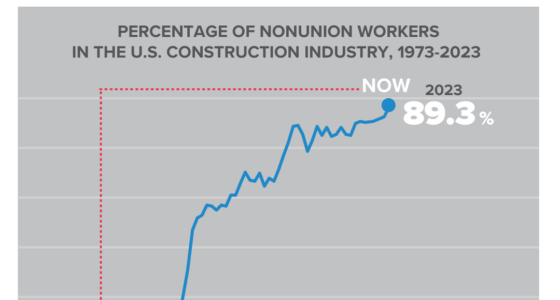
It is a raw deal for an industry workforce already facing a 17.2 percent unemployment rate, according to government data. It is especially discriminatory to the 86 percent of the U.S. construction workforce that choose not to belong to labor union.

In addition, PLAs saddle contractors with archaic and inefficient union work rules that needlessly increase construction costs.

Finally, PLAs typically force merit employers to pay employee benefits into union-managed multi-employer pension funds, but employees do not see the benefits of the employer contributions unless they join a union and become vested in these plans.

Qualified Nonunion Employees and Experienced Contractors Victimized by PLAs
An October 2009 report by Dr. John R. McGowan, “The Discriminatory Impact of Union Fringe Benefit Requirements on Nonunion Workers Under Government-Mandated Project Labor Agreements,” found that nonunion employees of merit contractors forced to work under government-mandated PLAs suffer a reduction in their take-home pay that is conservatively estimated at 20 percent.

Merit contractors that offer their own benefits, including quality health and retirement plans, often continue to contribute to both existing programs and union programs under a PLA.  The McGowan report found that nonunion contractors are forced to pay in excess of 25 percent in benefits costs above and beyond existing prevailing wage laws as a result of this “double payment” attached to PLAs.

These requirements make it difficult for nonunion contractors to compete and results in increased construction costs. It is also unfair to employees who have earned this money for a secure retirement.

PLA Mandates Increase Costs and Reduce Competition
The costly and discriminatory terms and provisions in typical PLAs discourage competition from nonunion contractors and increase the cost of construction. Numerous studies have found that government-mandated PLAs typically increase the cost of construction between 12 percent and 18 percent. That translates into less building and fewer construction industry jobs.

PLA Mandates Are Politically Motivated Solutions in Search of a Problem
The Obama administration justifies the use of government-mandated PLAs because they allegedly produce “economy and efficiency” in government contracting. However, no credible evidence supports this claim. In reality, PLA mandates are an earmark for Big Labor bosses and contractors justified as a solution to a problem that doesn’t exist in federal contracting.

GSA’s PLA Policy Investigated by Congress, but Remains Unchanged
The GSA has taken an aggressive and indiscriminate approach to promoting the use of union-favoring PLA mandates.

GSA policy permits firms to submit a PLA offer or, a nonPLA offer (or both) on all GSA projects exceeding $25 million in total cost. However, PLA offers submitted by bidders receive extra credit in the technical evaluation category of the best value procurement process. The special treatment makes it difficult, if not impossible, for non-PLA offers to win contracts when competing against PLA offerors (see the 9/24/10 PBS Procurement Instructional Bulletin (PIB) 10-04-Revision 1 for more details on this policy).

The GSA’s discriminatory PLA preference policy has led to delays, reduced competition and increased costs. Requests for congressional investigation forced the GSA to testify at two 2011 House Oversight and Government Reform Committee hearings to justify its wasteful favoritism.

See GSA deputy administrator Susan Brita’s attempt to justify the waste on the Lafayette Building at 44:16 of this hearing video and check out more highlights from the hearing after the jump.

Despite the congressional investigation, the GSA’s wasteful and discriminatory PLA preference policy remains unchanged. They refused to answer tough questions regarding their PLA policy and have provided the public with no evidence that it is beneficial to the public.

Union contractors and union construction workers continue to receive a considerable advantage when competing for contracts to build taxpayer-funded GSA construction projects. Numerous projects have been awarded to contractors submitting PLA bids at the expense of qualified firms opposed to PLA mandates. Full and open competition has been curtailed in violation of the federal Competition in Contracting Act. Taxpayer dollars have been wasted. Skilled nonunion craftspeople and their qualified employers have been denied jobs and opportunity as a result of this needless policy.

The waste and favoritism of the GSA’s PLA policy is comparable to the waste documented in the recent IG’s report.  If unchallenged, federal agencies will continue their unfortunate track record of waste, fraud and taxpayer abuse.

Congress and the media should renew their interest in the GSA’s anti-competitive procurement practices and call for reform. The GSA needs to be held accountable for any instance of waste, whether it be procuring conferences or construction services.

Home Get the Truth About Us Home Sign Up To Get Email Alerts About PLAs Send Us A Tip! Help Us Tell The Truth About This Critical Issue