










Boston Globe Editorial Board Slams Massachusetts Governor’s Pro-Project Labor Agreement Executive Order
On March 11, 2025, Massachusetts Governor Maura Healy (D) issued Executive Order No. 641 Using Project Labor Agreements to Promote Successful Delivery of Major Projects. The EO, announced at the Massachusetts Building Trades Annual Convention, seeks to encourage government-mandated project labor agreements on state construction projects estimated to cost $35 million or more.
The EO is similar to the anti-competitive and inflationary Biden EO applying to all federal construction contracts pf $35 million or more procured by federal government agencies that has been partially rolled back by the Trump administration following a successful legal challenge in the U.S. Court of Federal Claims.
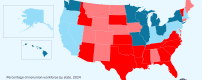
On March 17, the Boston Globe Editorial Board published a strong #NoPLAs editorial (pdf), slamming Governor Healey for issuing a “bewildering” EO that “helps stifle competition in public construction and, therefore, increase costs.” Further, the article notes that the EO tips the scales in favor of union labor against 80% of Massachusetts’ private construction workforce that freely chooses to operate nonunion.
“If a PLA requires union labor — and all that I have known in over 30 years in the business have — that takes nonunion labor and contractors out of the process,” Greg Beeman, CEO of Associated Builders and Contractors of Massachusetts.
The editorial calls Governor Healey out for pushing a scheme that is harmful to local businesses and construction workers.
Likewise, the editorial points out how the EO is a costly solution in search of a problem while The Bay State faces severe budget deficits.
The Boston Globe also reminds readers that even prominent Dem. Governors have spoken out against PLA mandate legislation due to increased costs associated with PLA mandates and preferences.
Prior to the EO the Massachusetts legislature gave a legislative green light to PLAs following an unfavorable court decision that led the Boston Globe editorial board to declare that Project Labor Agreements Are Bad Policy in a prior smackdown of PLAs.
Massachusetts is the latest blue state to enact policies promoting government-mandated PLAs and preferences on taxpayer-funded construction projects.
Governors and mayors from Oregon, Hawaii, Washington, D.C., Maryland, Pennsylvania and Delaware have come under fire for pro-PLA EOs and policies.
These blue state governors are ripping off federal taxpayers with their pro-PLA policies that increase costs on state/local government-mandated PLA projects when it receives federal financing and tax incentives.

Earlier this year, a coalition of 25 construction industry stakeholders sent a letter to President Trump and Congress to pass an EO and legislation (the Fair and Open Competition Act, S.1064/H.R. 2126) ensuring fair and open competition on federal and federally assisted construction projects, which will save taxpayers an estimated $10 billion.
Construction industry stakeholders can take action to help get these FOCA policies over the finish line.
Check out the Boston Globe editorial below.
Healey’s timing on project labor agreements misses the mark
Faced with federal funding cuts that threaten to drive a giant hole in the state’s budget, a crisis in housing construction, and deteriorating state roads and bridges, what does Governor Maura Healey do? Well, she doubles down on a policy that helps stifle competition in public construction and, therefore, increase costs.
That’s the kind of twofer the state really doesn’t need right now.
Last week the governor issued an executive order aimed at encouraging the use of project labor agreements on public construction projects with estimated costs over $35 million. And lest there be any doubt about who benefits, she made the announcement at the Massachusetts Building Trades Unions convention.
In a state grappling with the high cost of well, almost everything, the order sends the wrong message, even if its practical impact is uncertain.
The move came just months after she signed a $4 billion economic development bill that included a similar provision allowing municipalities and any government entity to enter into a project labor agreement if that agreement “is in the best interest of the commonwealth, public agency, or municipality.”
While the state’s construction workforce is more than 80 percent nonunion, Healey’s order and project labor agreements generally put the state’s thumb squarely on the side of union labor.
“If a PLA requires union labor — and all that I have known in over 30 years in the business have — that takes nonunion labor and contractors out of the process,” Greg Beeman, CEO of Associated Builders and Contractors of Massachusetts, told the editorial board.
Beeman added, “The executive order doesn’t break any ground” in the wake of the earlier legislation, “but in our view it’s really about expressing a preference.”
The sudden Trumpian popularity of executive orders aside, Healey’s office insists the order “provides a framework” above and beyond the legislative effort signed last fall.And the biggest state construction project on the horizon would be the $2.42 billion planned replacement of the Cape Cod bridges.
“There are so many critical construction projects underway all across the state — upgrading our roads and bridges, improving infrastructure for small businesses and more,” Healey said in a statement. “We know that it’s really important that these projects are set up for success. This means ensuring that contractors have a trained and ready workforce to turn to and a plan for meeting deadlines, staying within budget and keeping everyone safe.”
But there are a host of state laws and regulations already aimed at doing exactly that. Assuring that happens — that bidders on public projects are licensed, qualified, and have a good track record — is what the state’s Division of Capital Asset Management and Maintenance does.
State law also requires all contractors — whether union or not — to pay the prevailing wage on public construction projects, so one can’t argue these agreements are about assuring good wages for workers.
What PLAs do is add a layer with a history of limiting the number of potential bidders on any one project. And limiting bidders means the price is quite likely to be higher.
A recent example at the local level was a Westfield water treatment plant, the subject of a 2024 lawsuit brought against the Springfield Water and Sewer Commission whose own consultant warned that a PLA would add some $15.5 million to the estimated $325 million project.
Superior Court Judge Michael Callan found that the PLA was unjustfiable. Relying in part on a 1999 Supreme Judicial Court decision that limited the use of PLAs, he added, “The public interest is manifest. The public benefits from an open, fair, competitive, and robust bidding process. The PLA requirement unnecessarily curtails that without legal justification.”
In labor-friendly Massachusetts, Healey is jumping on a bandwagon that seems to be losing support, even among her fellow Democratic governors. Governor Janet Mills of Maine vetoed legislation in 2023 that would have mandated PLAs on offshore wind projects, noting that more than 90 percent of Maine construction workers are nonunion and a PLA “could stifle competition.”
Governor Gavin Newsom of California, also looking for a little more bang for the public buck on state university building projects, vetoed a similar bill, writing the requirements “could result in additional cost pressures.”
All of this comes as Healey noted just last week in an interview on WGBH, “I want to be clear with the public: We do not have enough money as a state, we do not have enough money to even begin to make up for the [federal] shortfall.”
And that makes the executive order that much more bewildering — at this particular moment in time — except as an effort to curry favor with union leaders.
There is, as Healey’s office insists, no mandate involved in either the earlier law or the executive order.
Well then, so far, so good — and may both remain just words on paper.
Editorials represent the views of the Boston Globe Editorial Board. Follow us @GlobeOpinion