










Maryland Gov. Wes Moore’s Project Labor Agreement Executive Order Will Hurt Maryland’s Construction Workforce and Firms
On Nov. 17, 2023, Maryland Gov. Wes Moore issued an executive order that requires the consideration of union-favoring project labor agreements on construction contracts procured by state agencies where the state’s financial commitment is $20 million or greater. The EO also includes new community benefit agreements and government-registered apprenticeship policies in addition to troubling pro-PLA language.
Maryland construction industry stakeholders are concerned this new policy’s pro-PLA language will result in inflated construction costs and reduced competition from more than 90% of Maryland’s construction workforce who choose not to join a union and have successfully built Maryland’s taxpayer-funded construction projects. Taxpayers have had been subjected to a number of broken promises by PLA advocates on failed PLA projects in the DC/MD/VA region.
The EO was signed at a press conference in Baltimore and was followed by a press release identifying $9 billion worth of Maryland infrastructure projects receiving federal government funding where PLAs will be considered.

The Moore EO was applauded by the Baltimore/DC-Metro Building Trades Unions, a council of construction trade unions representing construction workers across the mid-Atlantic area who stand to benefit from jobs created exclusively for them via PLA schemes.
On Nov. 13, Gov. Moore stood alongside Biden administration officials (Acting Labor Sec. Julie Su and White House Infrastructure Coordinator Mitch Landrieu) and announced his administration’s commitment to “high labor standards” on forthcoming federally assisted construction projects in Maryland:
“In the state of Maryland, we will work with the Biden administration to ensure that federal projects in Baltimore operate under the highest possible labor standards, including the Maryland Department of Transportation’s commitment to labor agreements for a number of strategic projects across the agency portfolio,” said Gov. Moore. “Partnership drives progress and we are going to keep moving in partnership with our friends in the White House, in Congress and with our unions to create good-paying jobs.”
Under Maryland’s existing prevailing wage law, contractors must pay construction workers wages and benefits typically aligned with union collective bargaining agreements.
However, when mandated or given preference on public works projects, PLAs severely restrict opportunities for Maryland’s construction workforce, thus opening the door to out-of-state contractors and employees affiliated with unions taking work from quality large and small Maryland contractors and their experienced construction workforce.
For any projects covered by government-mandated PLAs, contractors must negotiate and sign a PLA, which is an agreement with multiple construction trade unions, as a condition of winning a public works contract. Typical PLAs contain provisions that require contractors to hire most or all of their workforce for a project through construction union hiring halls, effectively requiring nonunion companies to forgo their existing Maryland workforce and instead hire unfamiliar workers, the majority of which will be from outside Maryland. Union hiring rules give preference to their members with seniority, regardless of where they are from.
Additionally, every worker, union member or not, is typically required to join a union and/or make contributions to the unions’ training, pension and health care plans, regardless of whether they benefit from the plans or receive duplicative benefits from their current employer. This leads to an estimated wage reduction of 34% for nonunion construction workers. In addition, these requirements effectively prohibit Maryland’s construction firms from competing for these projects, as duplicative benefits costs and union work rules in typical PLAs make them less competitive and also expose firms to future multiemployer pension plan liabilities.
When then-candidate Moore toured ABC Greater Baltimore’s multicraft training center in 2022, he acknowledged union-only PLAs can harm local workers, explaining, “I am not going to sign anything that is going to send Maryland jobs to Pennsylvania and New Jersey.”
In addition, the EO fails to take into consideration the impact PLAs have on construction costs. Numerous academic studies have compared the impact of affordable housing and school projects built with and without PLA mandates and have found that, on average, government-mandated PLAs increase costs between 12% and 20% compared to projects that are competitively bid through fair and open competition.
Unsubstantiated claims that PLAs benefit historically disadvantaged communities and businesses are undermined by strong evidence that this is not the case in many marketplaces and Baltimore’s minority contractors have vocally opposed efforts by City of Baltimore lawmakers to require PLAs on local projects.
ABC Maryland chapters have reached out to the Moore administration seeking clarification about many aspects of this executive order and new policy.
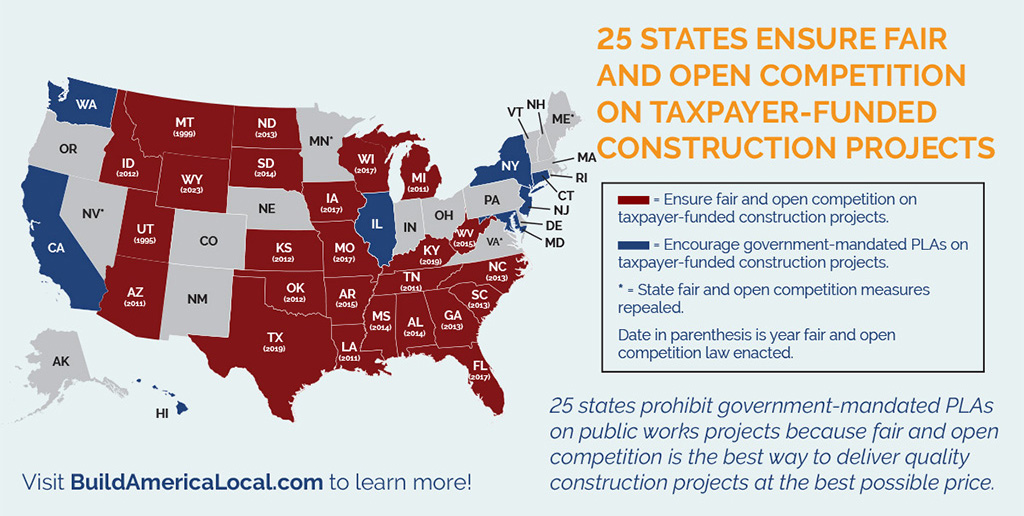
Maryland is 1 of 9 states that have enacted legislation or executive orders strongly encouraging or requiring government-mandated PLAs on state construction projects. In contrast, 25 states have passed laws prohibiting government-mandated PLAs on state, state-assisted and local construction projects to some degree.
Stay tuned for additional information and action items that will help fight for fair and open competition for ABC member businesses and Maryland’s construction workforce on taxpayer-funded infrastructure projects.
Update June 12, 2024:
Maryland Gov. Wes Moore issued revisions to his previous executive order (01.01.2023.19) regarding project labor agreement usage on large-scale state construction of $20 million or more in total project cost. These changes center around the use of PLAs on design-build and progressive design-build public works, the presence of federal assistance in project finances and the requirements around notification of decisions on PLA use in project solicitation documents.
These changes are assumed to be directly related to the rebuild of the Francis Scott Key Bridge over the Port of Baltimore that collapsed on March 26 after being struck by a container ship. Both federal and state stakeholders are engaged in the planning stages of the rebuild, including the Maryland Transportation Authority and the Federal Highway Administration, and ongoing regulatory and political wrangling will determine the financial and construction-related delivery of the project. Democratic leadership in both Maryland and the federal administration are assumed to heavily favor PLA use and other organized labor-friendly procurement policies in procurement of services for the rebuild.
Specifically, the new order from Gov. Moore declares where “receipt of federal funding or reimbursement” is present, state discretion will determine whether that investment is included in the triggering financial amount of $20 million or more in project cost for PLA use.
It also declares that, in a public multiphase design-build or progressive design-build project, written notification of the findings around the decision to use PLAs or to include the use of PLAs as an evaluation factor will not be required until the construction phase of the project, and written notification of the inclusion of PLAs and/or PLA-related evaluation factors in that phase will be provided in the initial solicitation.
Additionally, the order includes language declaring that, “in a multi-phase design build or progressive design build public work contract, the consideration of community hiring, training, and/or outreach plan for high unemployment areas is not required until the build/construction phase of the project.”
These changes seem to be related to the recent request for proposals for the multiphase bridge rebuild project issued by the Maryland Department of Transportation that directly addresses PLA use, specifying that the “MDTA will be evaluating whether to require a PLA for Phase 2 of this Project, subject to FHWA approval. … If a PLA is not utilized, the Design-Builder shall work with MDTA to include workforce development opportunities for the construction trades.”
The order from Gov. Moore, the RFP for the bridge rebuild and public indications from officials indicate that PLA use on the rebuild will be heavily considered and state policy may accommodate those decisions. The results of those decisions remain to be seen.
Under leadership of the three Maryland ABC chapters—ABC of Greater Baltimore, ABC Chesapeake Shores and ABC Metro Washington—and other stakeholders, an industry coalition effort, the MD Coalition 4 Fairness and Open Competition, is underway to educate Maryland taxpayers, the governor’s office and state regulatory officials and legislators on the harmful effects of government-mandated PLAs on public works, monitor their use in the state and find alternative outcomes when considering large-scale projects. For more information on this effort and to take grassroots action to communicate with Maryland officials, visit the coalition website, take action and share the below image and QR code to spread the message.
ABC National and the MD Coalition 4 Fairness and Open Competition will continue to monitor the conversation around government-mandated PLAs in Maryland, including their specific use on the Francis Scott Key Bridge rebuild, and will provide relevant updates.

Update September 6, 2024:
Maryland House Republicans issued a public letter to the governor on Tuesday stating that the policy puts Maryland construction workers at a competitive disadvantage by favoring union interests when awarding construction contracts for projects where the state has committed at least $20 million. According to an article from the Daily Record, “GOP legislators claim Moore’s labor union policy is hurting MD workers, 9/6/24″:
“I certainly think that the Moore administration is predisposed to help entities and organizations with political arms that can help them,” he said in a recent phone interview.
In 2023, roughly nine in ten construction workers in Maryland weren’t part of a labor union, according to the Union Membership and Coverage Database from the federal Current Population Survey, which compiles labor force statistics.
Buckel, House Minority Whip Jesse Pippy and Harford County Del. Mike Griffith claimed in their letter that House members have heard from construction workers and businesses who’ve lost out on state contracts because of the requirements established in the executive order.