










Oregon Editorial Exposes Gov. Kotek’s Project Labor Agreement Gift to Unions
The Oregonian editorial board had some choice words about Oregon Governor Tina Kotek’s (D) gift to construction trades unions in the form of a new executive order requiring controversial project labor agreements that are sure to inflate the cost of state and state-assisted construction projects funded by taxpayers (“Editorial: Merry Christmas, Labor Unions! Love, Gov. Kotek,” Jan. 12, 2025):
In the week before Christmas, Gov. Tina Kotek delivered quite the gift to her labor union allies. Kotek issued a surprise executive order requiring contractors on major state-funded projects to collectively bargain with labor unions over wages, benefits and other conditions for their workers on these projects – even if their workers aren’t unionized.
Unfortunately, Kotek’s generosity comes at a cost for Oregonians. Such mandates for “project labor agreements” undermine the open and competitive process that state law and good governance call for. Research and experience show they also typically add costs for public projects, which already face increasing prices for materials. And the governor’s poorly-worded order, made without input from contractors, has generated questions about whether the requirement applies to local affordable housing efforts, university projects and school renovations. Her office is now clarifying that it will only apply to projects owned by the state. With Oregon facing so many deep crises that need the governor’s focused attention and pragmatic leadership, Kotek should listen to contractors’ many legitimate criticisms, avoid the potential for drawn-out legal battles and reverse course on her sweeping order.
As written, the order calls for all state agencies awarding contracts or providing funds for significant construction projects to require project labor agreements – PLAs – between contractors and labor unions representing electricians, plumbers and other trades. Under such a requirement, contractors must commit to negotiating a comprehensive set of terms with labor unions in order to bid on the work. These agreements cover far more than wages, which already must meet state minimums for projects of a certain size. Rather, they can include provisions that contractors hire workers only through union-controlled processes, require union dues from workers and mandate contributions to the union’s health and retirement plans – even if those workers, who are otherwise not union members, will likely never benefit from them. In fact, the vast majority of contractors and subcontractors are not unionized, with estimates of 75% or more being nonunion shops.
There are certainly instances in which contractors and labor unions have voluntarily set up project labor agreements, particularly for time-sensitive, complex projects. But there’s been an ongoing battle over the state’s attempts to force contractors to accept labor union participation in major transportation contracts – a legal dispute currently under consideration by the Oregon Supreme Court. Kotek’s order mandating PLAs for state projects in which labor accounts for at least 15% of the cost not only escalates that battle, but appears to go beyond what any other state has in place. Oregon once again is at the forefront of an economic experiment that shows little, if any, upside for the public.
Kotek contends that her executive order will provide more certainty and help control expenses because the project labor agreements will prohibit strikes and other costly work stoppages. However, her office could not point to a single such incident that shows this is a problem needing to be solved. Rather, when asked for an example, her office wrote that Kotek “was not looking backwards but ahead to several large infrastructure projects that will need stable and sufficient skilled labor to complete. Broad adoption of PLAs across the enterprise will help build a pipeline of skilled workers in Oregon so that contractors do not need to pull in workers from out of state.” Kotek’s order also explicitly notes the labor agreements will help advance the goal of gender and racial equity in contracting by including specific targets.
But the governor’s action ignores the work contractors are already doing to build the workforce and fails to consider the cost impacts. California Gov. Gavin Newsom vetoed a bill last year that would have mandated project labor agreements for state projects of at least $35 million, specifically calling out the “significant fiscal implications.”
Oregon has its own first-hand experience. The Oregon Department of Transportation issued a bid last September for companies interested in work on the Newberg-Dundee bypass and imposed a project labor agreement requirement. Only one firm submitted a bid, which came in 22% above the agency’s projections, prompting the Oregon Transportation Commission to forward an additional $5.9 million for that phase of the project. While some of the increase stemmed from higher materials costs, ODOT also noted higher employee costs for missing the estimate.
The governor’s office concedes that “the state’s inconsistent and infrequent use of PLAs in the past also lent itself to receiving fewer bids on projects where PLAs were required.” But the solution Kotek offers is baffling. Her office contends that “broad usage and acceptance of the tool will address this issue moving forward.”
So, increasing the cost of doing business on more projects will somehow result in a lot more bids and lower estimates? That’s some funky math.
Contractors – even those whom Kotek contends will benefit – aren’t buying it. Nate McCoy, president of the Oregon chapter of the National Association of Minority Contractors, said his organization strongly opposes the executive order. Many members are small firms unable to absorb the added administrative and operational costs that come with project labor agreements, he said. “We believe that creating opportunities for minority-owned businesses to thrive in an open and competitive environment, with equitable access to resources and support, is the best way to achieve racial equity,” he told the editorial board.
Similarly, Mike Salsgiver, executive director of Associated General Contractors’ Oregon-Columbia chapter, questioned what benefits Oregon will derive. “PLAs inflate project costs, meaning taxpayers will get less for their money, either through higher taxes or fewer completed projects,” he said in a statement. AGC, which is already involved in the case before the Oregon Supreme Court, is evaluating its options on how to respond to the order, he said.
But Kotek can end this by doing the sensible thing and rescinding her executive order. This is one gift she should take back.
TheTruthAboutPLAs agrees.

ABC Pacific Northwest and Associated General Contractors’ chapter serving the Oregon market pushed back on Gov. Kotek’s press release and flawed rationale supporting the PLA EO, which was picked up in this Oregon Daily Journal of Commerce article, “Oregon Construction groups blast union labor rule,” Jan. 7, 2025:
The PLA policy “will needlessly inflate the cost of state government-procured and -funded construction projects by 12 percent to 20 percent and discourage competition from local quality contractors and their skilled workforce who have successfully built public works projects in Oregon for decades,” Laurie Kendall, president of Associated Builders and Contractors’ Pacific Northwest chapter, stated in a news release.
To some observers, Kotek’s order demonstrated the sway of organized labor on the state’s Democratic leadership.
“Kotek’s anti-competitive and inflationary executive order ensures that taxpayer-funded construction projects are steered to union-signatory firms and will be built by union labor —including out-of-state union labor — even though only 14.9 percent of Oregon’s construction workforce is unionized,” Kendall stated.
The Oregon DJC article also articulates the negative affect of government-mandated PLAs on minority contractors, which is a common complaint against PLAs expressed in many states across America:
“Sweeping changes like this harm minority contractors, exacerbating systemic disparities and leaving many businesses shut out of opportunities they’ve worked hard to access,” Nate McCoy, president and CEO of the National Association of Minority Contractors, Oregon, stated in a news release.
Get the facts about government-mandated PLAs and Gov. Kotek’s pro-PLA EO from ABC Pacific Northwest’s press release.
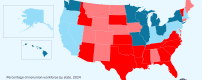
Oregon is the latest blue state to enact policies promoting government-mandated PLAs and preference on taxpayer-funded construction projects.

The most recent states to enact pro-PLA policies have been Massachusetts, Hawaii, Washington, D.C., Maryland, Pennsylvania, and Delaware.
An industry-supported Trump administration executive order restoring fair and open competition on federal and federally assisted construction projects could protect any of Oregon’s state and state-assisted construction projects that receive federal funding/grants by prohibiting PLA schemes as a condition of federal financial assistance. A Trump policy would protect taxpayer-investments in infrastructure by restoring fair and open competition, saving an estimated $10 billion for taxpayers annually.
2/1/25 UPDATE: An article reported that Gov. Kotek’s EO is contradicted by a 2022 Oregon Department of Transportation Analysis of PLAs that contradicts the alleged benefits of PLAs Kotek touted (Kotek’s Figt to Trade Unoins Contradicts ODOT’s Analysis, 1/29/25):
The study, obtained by the Oregon Journalism Project, drew on studies of more than 1,000 PLAs around the country and reached two key conclusions.
First, PLAs result in fewer bidders. “There is a consistent trend: that of open shop [nonunion] contractors not bidding on PLA projects,” the report found:
Fewer bidders means less competition, which ODOT found leads to higher costs. “The PLA analysis found the inclusion of a PLA was strongly correlated with increased construction cost within the range of 10% to 20%,” the ODOT report says.
Department spokesman Kevin Glenn says the results of the analysis might not apply to all projects. “ODOT believes including project labor agreements on more projects, as directed by the governor’s executive order, can be done in a cost-effective manner,” Glenn says.
Over the past year, ODOT has been very public about its desperate financial condition. The only thing in worse shape than Oregon’s 8,000 miles of highways and 2,700 bridges is the agency’s balance sheet.
In short, ODOT director Kris Strickler has told lawmakers that the agency is broke. “In the absence of action, service will be severely reduced,” Strickler says in a presentation he has delivered repeatedly.
ODOT’s projected costs are running so far ahead of revenues that Strickler raised the prospect last year of laying off 1,000 workers, one-quarter of the agency’s staff. Meanwhile, he and lawmakers toured 12 cities across the state trying to build support for budget increases and a long list of big projects, including expanding Interstate 5 in Portland and building a new bridge to Vancouver.
But according to ODOT’s 2022 analysis, Kotek just made those projects the department already cannot afford 10% to 20% more expensive.
Kotek, a Democrat, won election in 2022 with the strong support of organized labor. (Trade unions contributed more than $1.2 million to her campaign.)
Spokeswoman Roxy Mayer denies Kotek is favoring the trade unions over the public’s interest. “The governor has always been clear about her personal commitment to both good governance, and supporting workers and communities,” Mayer says.
In an FAQ that accompanied her Dec. 19 executive order, Kotek said PLAs would “provide benefits to the communities where [projects] are constructed.”
Chris Doty, director of public works at Deschutes County, begs to differ. He’s experienced firsthand what Kotek’s executive order will mean in practice: a policy that will benefit mostly urban workers at the expense of rural Oregonians. “It’s really frustrating,” he says.
Kotek’s executive order followed a tumultuous year in which ODOT tried to implement eight PLA pilot projects around the state. Those projects included highway and bridge work spanning 12 counties. The projects’ price tag: $280 million, more than 40% of ODOT’s budget.
Doty’s team in Deschutes County was supposed to partner in one of those projects: a $30 million rebuild of the intersection of Highway 97 and Lower Bridge Way at the north end of Terrebonne. The county and ODOT would share in the cost. But when Doty looked at what the PLA entailed, he was dismayed.
First, he wasn’t at all confident that anybody would bid on the project. “There are no union contractors I’m aware of east of the mountains that do heavy road work,” says Doty, who has been building roads for 24 years and regularly speaks with peers in other county road departments.
(His view is consistent with ODOT’s analysis. The agency reviewed its construction contracts from 2017 to 2022 and found that two-thirds of them went to nonunion shops. For larger contracts — $25 million and above — the split was even bigger: 89% of such contracts went to nonunion firms.)
Since there were no union shops in Deschutes County, Doty says, the entire project was likely to be staffed by firms from the Willamette Valley or Southwest Washington.
Doty worried about the additional cost of limiting the bidding pool. When he read the fine print of the proposed PLA, however, he found it “stunning.” The contract also required that 29% of the labor be supplied by workers who live in an “economically distressed ZIP code.”
But according to the state’s list of such ZIP codes, there was none in Deschutes County.
That meant that for a project for which Deschutes County was putting up $10 million, 29% of the workers could not live in the county. “It was totally ridiculous,” Doty says.
Mayer, the governor’s spokeswoman, says the state will keep a close eye on costs, and Kotek’s order will deliver benefits to people who often get left out of public contracting.
“PLAs can and should be a tool to reduce workforce disparities and lift up small businesses,” Mayer says. “The governor’s order directs state agencies to set targets for the use of Office of Business Inclusion and Diversity-certified firms.” (Such companies must be owned by minorities, women or service-disabled veterans and/or be emerging small businesses.)
2/21/25 UPDATE: A broad coalition of Oregon construction groups has filed a lawsuit challenging Gov. Kotek’s PLA EO. More from a Feb. 21 press release:
The Associated General Contractors, Oregon-Columbia Chapter, Associated Builders and Contractors, Pacific Northwest Chapter, Northwest Utility Contractors Association, the National Federation of Independent Business, along with thirteen Oregon contractors are jointly challenging the executive order’s anti-competitive nature and the fact that it runs contrary to findings by the Oregon Department of Transportation that project labor agreements will increase costs to the state.
In addition to cost concerns, the suit argues that the governor exceeded her executive authority in issuing the order. “We believe that the governor exceeded her executive powers and created and anti-competitive environment, disregarding the advice of one of her own agencies regarding the added cost to Oregon taxpayers,” stated Mike Salsgiver, CEO of the Associated General Contractors, Oregon-Columbia Chapter.
Studies have shown that union-only PLAs needlessly increase construction costs by 13 to 20 percent, while not increasing wages or worker benefits. The Willamette Week newspaper uncovered an analysis by the Oregon Department of Transportation (ODOT) that found that requiring PLAs on the agency’s projects would increase taxpayer costs 10-20%.
The suit (p. 14-15) quoted from ODOT’s October, 2022 Cost Risk Assessment, or CRA, noting that:
This cost increase was attributed to PLAs limiting the bid pool and PLAs increasing labor and/or administration cost. The CRA found “that open shop contractors do not bid on PLA projects at an alarming rate[]” and puts “non-DBE subcontractors at a significant competitive disadvantage[.]” Regarding overall project cost, the CRA concluded that “[a] PLA will almost certainly increase the project’s construction cost; the uncertainty lies in the magnitude of increase.”
“The last thing Oregonians can afford right now are the higher costs and cost overruns that come with union-only PLAs,” Laurie Kendall, President of the Associated Builders and Contractors, Pacific Northwest Chapter said. “A recent study of the impacts of a PLA on supportive housing projects in Los Angeles documented 21 percent in added and unnecessary costs to taxpayers. In fact, California’s governor, Gavin Newsom, vetoed a bill mandating PLAs because of the impact of their costs on the state’s budget.”
Here is a copy of the complaint and a toolkit of resources from the Oregon AGC chapter containing resources on this case.
One Response to Oregon Editorial Exposes Gov. Kotek’s Project Labor Agreement Gift to Unions
[…] example. Recently, Maryland is looking at PLAs for potentially $20 billion worth of work, and Oregon’s governor just issued an executive order pushing PLAs on certain […]