









Gov. Green’s New Project Labor Agreement Policy to Harm Hawaii’s Construction Workers and Businesses
Pursuant to Hawaii Gov. Josh Green’s (D) Administrative Directive (AD) 24-01, all contractors accepting awards for Hawaii executive agency construction procurements exceeding $1.5 million in cost to the state must execute an agreement to be bound by a standardized project labor agreement of general application throughout the state.
Effective February 16, 2024, AD-24-01 provides for no coverage exemptions and constitutes a radical intensification of the procurement discrimination arising from Gov. Neill Abercrombie’s AD 12-05, which authorized PLAs on projects exceeding $25 million.
In contrast to Gov. Green’s press release in support of PLAs, because the majority of Hawaii construction workers do not belong to a union, AD 24-01 will inflate project costs, protract project execution, and significantly exacerbate construction workforce shortfalls relative to record demand arising from unprecedented public infrastructure spending. AD 24-01 is the most extreme pro-PLA policy currently enforced by any state government.
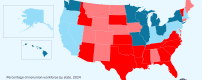
AD 24-01 permits contractors’ employment of no more than seven nonunion workers on covered work; requires covered contractors to discharge any employee within five days of the employee’s failure to authorize pay withholding for remittance to a union of “dues and fees in the amount designated by [the] union”; excludes from covered work enrollees in nonunion industry, federally-registered, and state-registered apprenticeship programs; and requires contractors to apportion covered work among union-designated crafts encompassing limited sets of tasks, significantly limiting the diversity of tasks performable by each covered employee. Nonunion contractors, whose employees comprise about 62% of Hawaii’s construction workforce, cannot comply with the foregoing conditions.
AD 24-01 coincides with sustained high levels of private permitting and with public construction spending forecast to push Hawaii construction workforce demand to the highest levels on record by 2027, according to the University of Hawaii Economic Research Organization (UNHERO). Hawaii is designated for the most federal military spending of any state for 2025, and UNHERO projects that present and near-term construction activity will significantly strain Hawaii’s construction workforce, requiring “an influx of construction workers from the mainland.”
By excluding 62% of Hawaii construction workers from employment on state projects, AD 24-01 functions to prospectively substitute Hawaii resident construction labor with non-resident union construction labor, diverting the benefits of taxpayer infrastructure investments from local economies to the mainland. Hawaii construction workers earn a mean hourly wage of $47.30. ABC estimates each $1 billion in public construction spending sustains 4,510 annual construction jobs or $39.7 million in wages. If Hawaii’s nonunion workers were replaced by out-of-state workers on public construction projects, each $1 billion in public construction spending would generate $12 million in wages for Hawaii residents, resulting in a loss of $27.7 million in wages per $1 billion in public construction spending.
Hawaii’s procurement regulations require that Hawaii residents perform 80% of work hours on state projects, prohibit unduly restrictive specifications, and require that public procurers ensure broad-based competition, economy, and best value to the maximum practicable extent via specifications providing fair and equal opportunity for every supplier able to meet the state’s needs.
In view of AD 24-01’s unlawfully anti-competitive impacts and significant adverse ramifications for Hawaii’s urgent wildfire recovery, resiliency, and housing affordability goals, ABC of Hawaii continues to advocate for AD 24-01’s rescission.

March 20, 2024 Update: Check out ABC Hawaii’s President Jeff Alameida discuss government-mandated PLAs in an interview with the Grassroots Institute of Hawaii: https://youtu.be/COhU9ziad44
Qualified Hawaii businesses employing almost 6 out of every 10 local construction professionals can’t win a contract and work on a jobsite unless they agree to the anti-competitive and costly pro-union terms in PLAs. It is no surprise such red tape and discrimination discourages competition from experienced merit shop firms and well-trained nonunion craft professionals in Hawaii.
Fewer bidders, coupled with costly and restrictive provisions in PLAs, needlessly increase construction costs. For example, academic research by various government and private institutions have determined affordable housing and school projects subject to PLA mandates are 12% to 20% more expensive than projects not subject to PLA mandates.
Are Hawaii residents willing to accept four schools, affordable housing, infrastructure and transportation projects for the price of five?
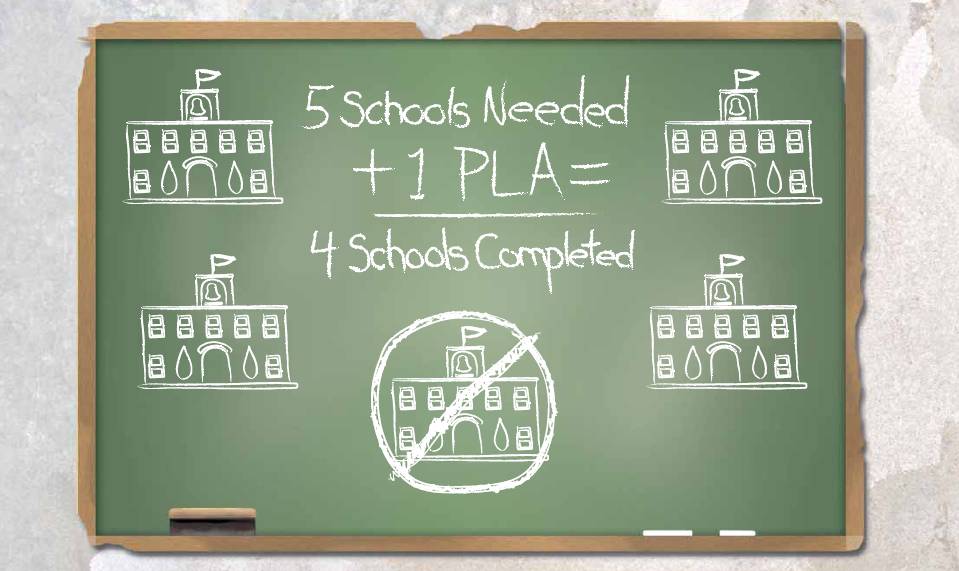
Are taxpayers willing to support policies and lawmakers that steer jobs and contracts to mainland union construction workers and firms so local residents can forego another school, transportation or infrastructure improvement?
Previous government-mandated PLA policies on City of Honolulu projects and the Honolulu rail system have already harmed local workers and delayed projects.
Increasing costs, chilling competition, placing barriers to new jobs for qualified Hawaii residents and rewarding well-connected special interests with government contracts is no recipe for equitable economic development and progress for Hawaii.